Biodiverse neighborhoods: an ex-situ conservation tool
DOI:
https://doi.org/10.1590/2447-536X.v28i1.2388Keywords:
phytosociology, planned neighborhood, urban conservation, urban forestsAbstract
Urban forests are responsible for a lot of benefits, and can be used as a tool to ex-situ conservation of native species. Our study investigated a public urban forest aiming to provide subside to management projects in order to allow the accurate fulfillment of social, aesthetic and ecological functions displayed by trees. Our survey was conducted in 6 public squares and 5 gardens in the Jardins neighborhood. We classified the trees according to their phytogeographic origins and seed dispersal habit. The Shannon- Weaver (H’) index, Simpson’s dominance (D’) and Pielou’s equability (J) were determined. A total of 507 individuals were sampled, located in 12 botanical families and 29 species, and 13 of them were classified as native and 16 as exotic. The family with higher species richness and number of species was Fabaceae (36%). Regarding the seed dispersal syndrome, the most representative was zoochory (52%). The ecological index showed medium species diversity (H’=2.2284), high dominance (D’=0.7899) and medium number of individuals (J) 0.6552. Although the Jardins neighborhood was planned, the urban forest in this area still needs improvement; such as incentive measures that can promote biodiversity and the application of ex-situ conservation.Downloads
Download data is not yet available.
Downloads
Published
2021-10-07
How to Cite
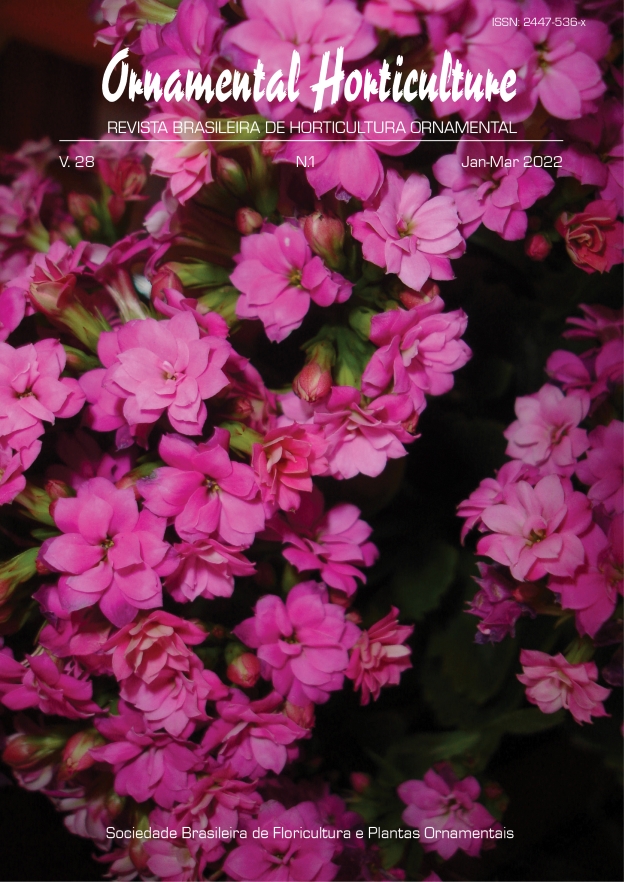
Ucella Filho, J. G. M., Lucas, F. M. F., Almeida, D. de M., da Silva, B. R. F., Almeida, D. de M., Brito, D. Y. O. de, & Azevêdo, T. K. B. (2021). Biodiverse neighborhoods: an ex-situ conservation tool. Ornamental Horticulture, 28(1), 8–18. https://doi.org/10.1590/2447-536X.v28i1.2388
Issue
Section
Articles
License
Copyright (c) 2021 João Gilberto Meza Ucella Filho, Fernanda Moura Fonseca Lucas, Débora de Melo Almeida, Bruna Rafaella Ferreira da Silva, Dayane de Melo Almeida, Dáfilla Yara Oliveira de Brito, Tatiane Kelly Barbosa Azevêdo

This work is licensed under a Creative Commons Attribution 4.0 International License.